
One system that
acts across itself.
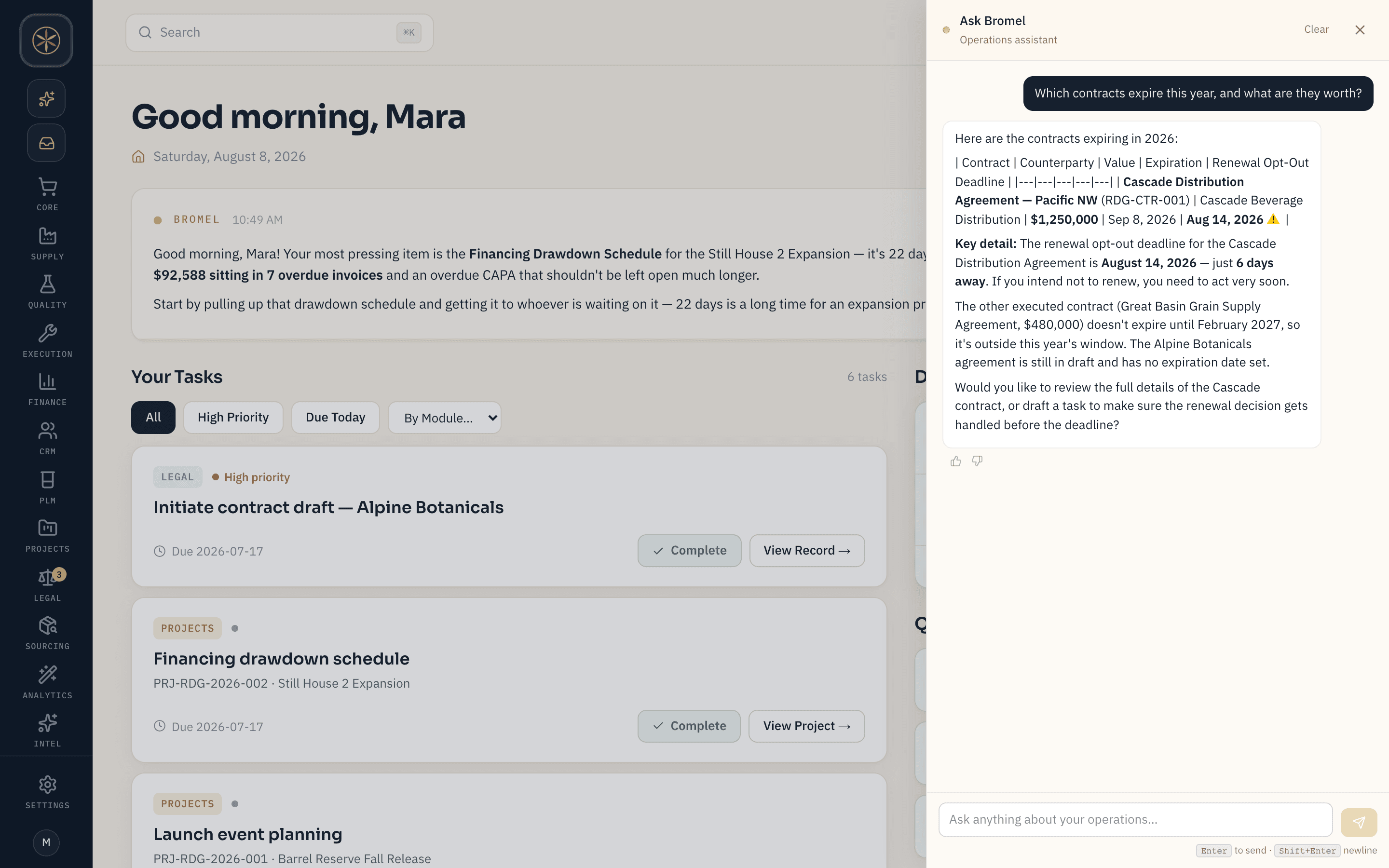
Buy one module or run the whole business on it. Implement it yourself with AI, not a nine-month engagement. And Bromel — the native chatbot, agentic workforce, and insight engine — ships inside every module, bounded by rules enforced in code.
Under 50 people? Meet VeredSB — four AI co-workers, one price →
Depth that rivals the category leaders
One system with the depth of a stack of best-of-breed tools — MRP, GxP quality, CPQ, treasury, contract lifecycle — not a shallow all-in-one.
A fraction of the total cost of ownership
One licence, one data model, zero integrations to build and own. The all-in cost of the five-vendor stack it replaces, without the integration tax.
Bromel is built in, not bolted on
A native chatbot, an agentic workforce, and an insight engine inside every module — bounded by guardrails enforced in code, not bought as an add-on.
VeredSB — a back office for manufacturers of 5 to 50.
Four AI co-workers go through your business every night — your receivables, your materials, your quality, your jobs — and hand you a short list in the morning. They propose. You decide.
Bromel Controller, QA Manager, Supply Planner and Project Manager. $1,250 per month, flat. Nothing to configure.
Buy one module. Or run the whole business on it.
Licensing is not a sales construct here — it is enforced in the product. Start with Legal alone if that is the fire today, and add Sourcing next quarter without a re-implementation.
- License modules per organisation — buy one, add more later, with the product genuinely enforcing itorganizations.enabled_modules
- Set permissions per role and override per userrole and per-user permissions
- Design an approval workflow in a builder and attach it to any moduleworkflow builder, any module
- Add your own fields without a developercustom fields, no developer
You run the migration. Not a nine-month engagement.
Map your columns, import, tie the result out against what you had, then go live. The tie-out is the part that usually costs a consulting phase, and it is a screen.
- Migrate your data yourself: map columns, import, tie out the result, then go livecolumn mapper, import, tie-out, go-live
- Integrate over webhooks and a documented API rather than a bespoke connector projectwebhooks and integrations
- Export your datayour data, exportable
- Run multiple facilities with their own work centres and transfers between themmulti-facility from the start
Bromel: the chatbot, the agents, the insights.
Bromel is the native chatbot, the agentic workforce, and the insight engine — ask questions of your own data, wake up to agent briefings, and get numbers computed by code. The part that matters to a regulated buyer is what it cannot do.
The work that appears without anyone asking for it.
This is the thing a best-of-breed stack cannot do at any price. Every route below is live in the product — and where it says you choose, it is a checkbox in your lifecycle builder, not a services engagement. New routes ship continuously and arrive the same way: as checkboxes, not change orders.
Awarding a bid files a task to draft the contract with the winning supplier
The same award files a task to set the supplier up in AP
Starting a supplier qualification files the document review with Quality
The same qualification files the credit check with Finance
Approving a qualification makes the supplier available to raise POs against
Rejecting a lot blocks the orders that depend on it
Advancing a product phase files a sourcing task — skipped if an event is already active
A phase can request a supply or launch agreement, linked to the product
A phase can open a draft change control, with category and regulatory impact preset
A phase can provision the product and item master into ERP and link specs and demand
A phase can inject a new-product demand adjustment into the S&OP overlay
End-of-life signals ramp-down demand using the record's cutoff dates
Start with the module that hurts most.
Then let it pull the next one in when it is ready to.