
VeredPLM
A lifecycle you define, phase by phase — and the rest of the business moves when a product does.
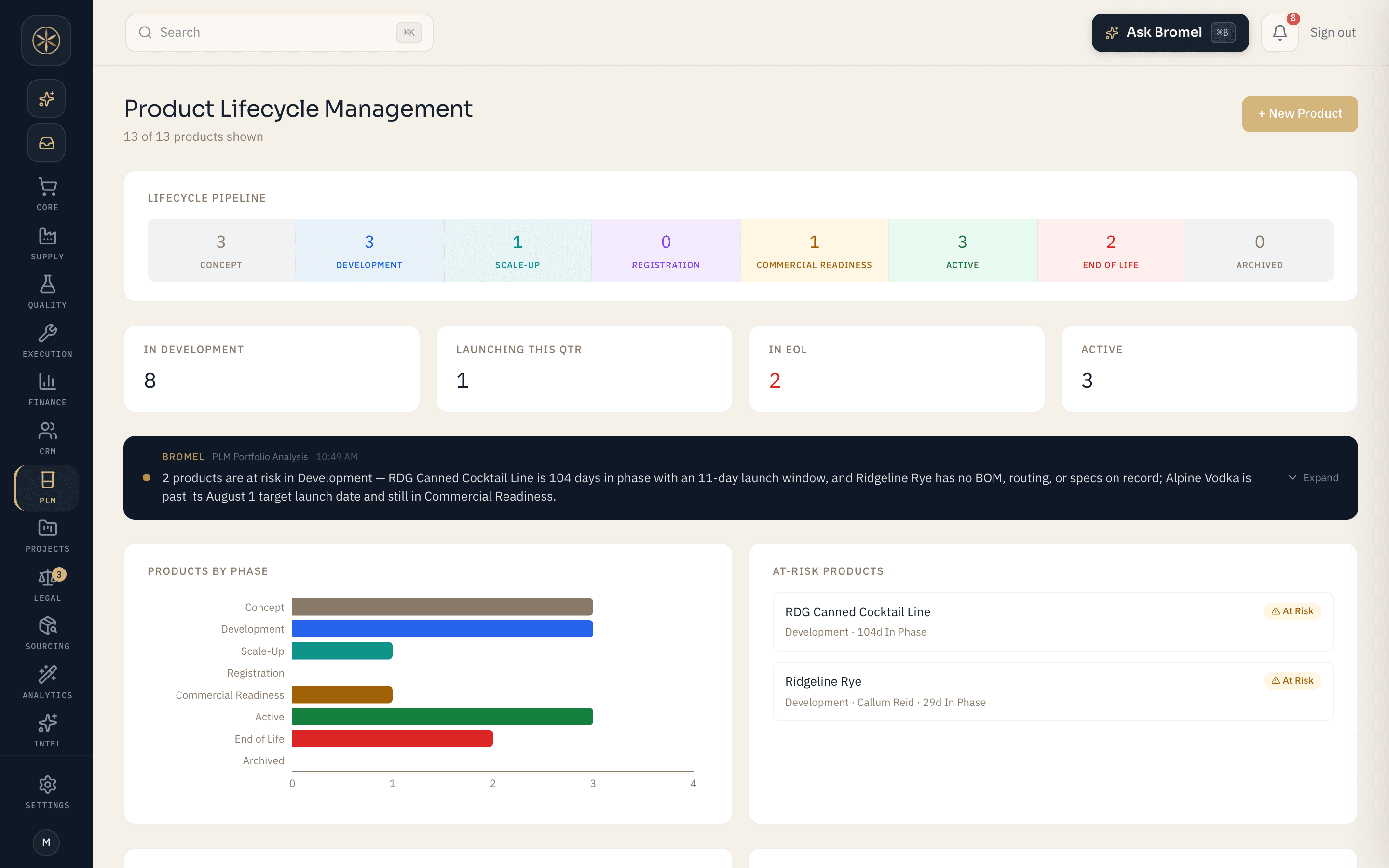
What it does
- Run a product through a lifecycle of phases you defined yourself
- Define a different lifecycle per initiative type — a line extension does not have to follow the same path as a new product
- Choose, per phase, what happens in other modules when a product reaches it — as checkboxes, not a consulting engagement
- Release a product to ERP as an item master, idempotently
- Triage end-of-life and signal the phase-out to demand planning
- Inject new-product demand into the S&OP overlay for the planner to size
Bromel in PLM
Not a bolt-on assistant. Bromel's tools here exist only when you license this module, and they read this module's data.
- The NPI portfolio: counts per lifecycle phase, plus the at-risk, delayed, and blocked products with their phase dates.plm_portfolio
What it sets off elsewhere
A point solution cannot do this at any price — it does not know your other systems exist.
Advancing a product phase files a sourcing task — skipped if an event is already active
A phase can request a supply or launch agreement, linked to the product
A phase can open a draft change control, with category and regulatory impact preset
A phase can provision the product and item master into ERP and link specs and demand
A phase can inject a new-product demand adjustment into the S&OP overlay
End-of-life signals ramp-down demand using the record's cutoff dates
VeredPLM vs. a dedicated PLM/QMS
Arena by PTC is a strong product record and earns its marks. The rows it cannot answer are the ones where a phase change moves the rest of the business — releasing to ERP, injecting launch demand into S&OP, opening the change control — because in Vered those are checkboxes on your lifecycle, not integration projects.
| Capability | Vered | Arena (PTC) |
|---|---|---|
| Run a product through a lifecycle of phases you defined yourself | ● | ●1 |
| Define a different lifecycle per initiative type — a line extension does not have to follow the same path as a new product | ● | not assessed |
| Choose, per phase, what happens in other modules when a product reaches it — as checkboxes, not a consulting engagement | ● | ◐2 |
| Release a product to ERP as an item master, idempotently | ● | ◐3 |
| Inject new-product demand into the S&OP overlay for the planner to size | ● | —4 |
| Ask questions of your own operational data in plain language | ● | ◐5 |
| Have named agents work overnight — controller, FP&A analyst, supply planner, production scheduler, quality manager, treasury analyst | ● | not assessed |
| One source of truth that acts — an event in one module files dated, assigned work in another, automatically | ● | ◐6 |
- 1.Core PLM — credit where due — Arena by PTC — cloud-native PLM and QMS (self-description), ret. 2026-08-08. https://www.ptc.com/en/products/arena
- 2.Workflows within the product record; reaching ERP, planning, or legal is integration work — Arena by PTC — cloud-native PLM and QMS (self-description), ret. 2026-08-08. https://www.ptc.com/en/products/arena
- 3.Via ERP integrations — Arena by PTC — cloud-native PLM and QMS (self-description), ret. 2026-08-08. https://www.ptc.com/en/products/arena
- 4.A product record by its own definition — S&OP demand planning is not in it — Arena by PTC — cloud-native PLM and QMS (self-description), ret. 2026-08-08. https://www.ptc.com/en/products/arena
- 5.Arena AI Assistant — real, and scoped to PLM/QMS workflows — PTC news — Arena AI Assistant for PLM and QMS workflows, ret. 2026-08-08. https://www.ptc.com/en/news/2025/ptc-launches-arena-ai-assistant
- 6.Unifies the product and quality record — operations, orders, and cash live elsewhere — Arena by PTC — cloud-native PLM and QMS (self-description), ret. 2026-08-08. https://www.ptc.com/en/products/arena
Run VeredPLM on its own.
Licensing is enforced in the product, so this module alone is a real option — and the rest is there when you want it.